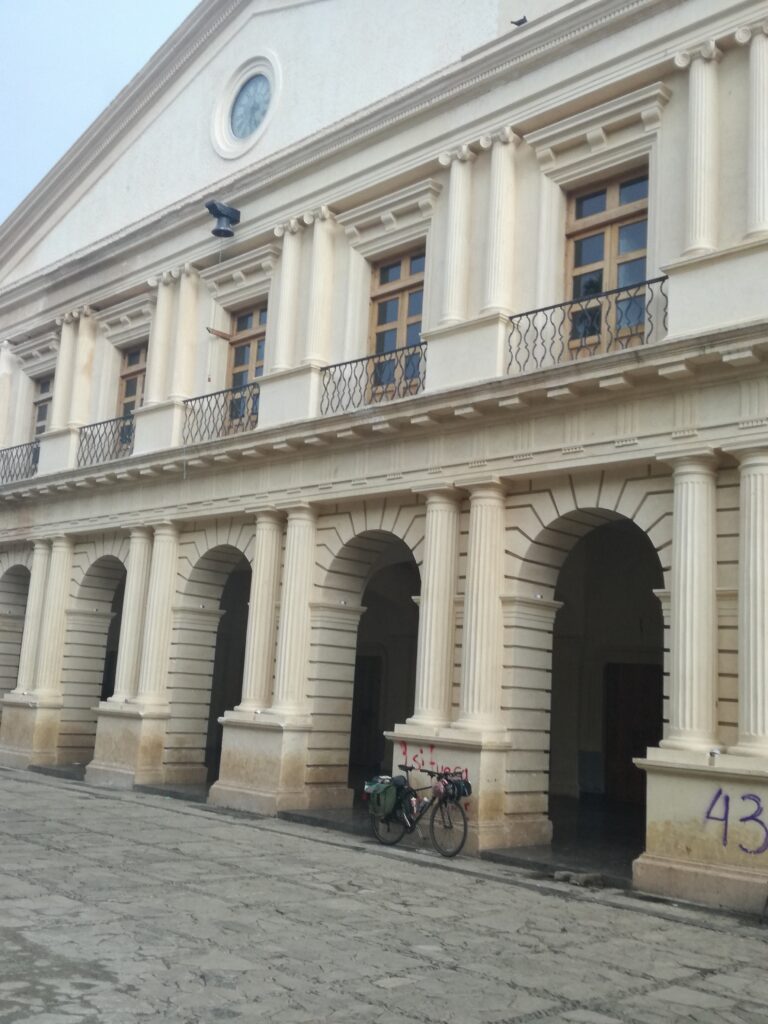
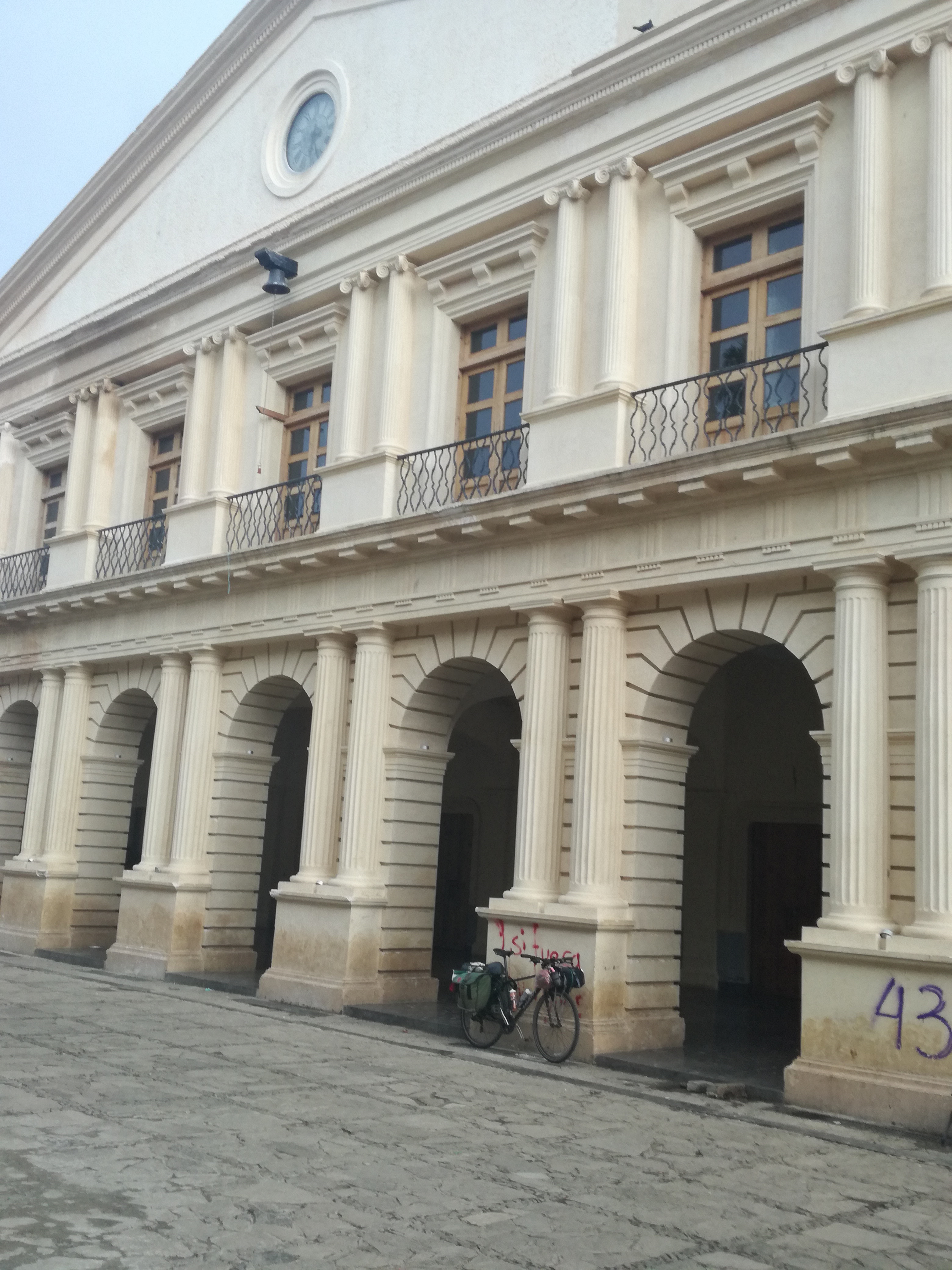
My bike is on the façade of the city hall of San Cristóbal de las Casas. The seizure of this building on 1 January 1994 by the EZLN marked the beginning of the Zapatista insurrection.
Comitán de Domínguez (Chiapas, Mexico) Km 4575
More than 24 years have passed since the Zapatista uprising that put on the map a Mexican state until then unknown abroad. Chiapas has an area equivalent to that of Aragon and Catalonia together, and not only is it very different from the rest of Mexico, Chiapas is also a very diverse and heterogeneous state. It has central and coastal plains, and other mountain and jungle areas where there is a clear predominance of the population of several indigenous ethnic groups, who dress in the traditional way (particularly women) and speak their own languages.
The Zapatistas have now retired to five populations (which they call 'snails') where they are governed by their own rules and the Mexican state does not intervene, but the indigenist movement goes beyond those five localities. In rural areas of indigenous dominance, there is a movement called 'Autonomous Peoples in Defense of Customs and Customs' which aims to ensure that communities are governed in accordance with indigenous traditions, even if they are contrary to federal or state laws. Taking advantage of my stay in San Cristóbal de las Casas (SCC) I took a bus to the Mayan ruins of Palenque (in the jungle area, more than 200 Kms) and during the journey we find the road cut in several points by groups of indigenous armed with stakes and machetes in protest of the power supply cut (for lack of payment) to several populations. The roadblocks ruined my excursion. The police (omnipresent in other states of Mexico) did not come to restore traffic, nor was it expected.
The coexistence between indigenous and non-indigenous communities is not easy. In my previous entry I was talking about the murder of two European cyclists on the road to the above-mentioned ruins of Palenque. Non-indigenous people attribute that murder, which remains unresolved, to a 'bad encounter' with indigenous people. At first it seemed to me that they were blaming the indigenous people for no reason, but after what I have learned about the indigenous people in these ten days I have spent in Chiapas, I also now think that this' bad encounter 'is the most likely cause of the murder.
San Cristóbal de las Casas is at the limit of indigenous and non-indigenous areas. These two communities present in the city are joined by many Westerners who have come to work on cooperation projects and NGOs taking SCC as their base of operations. To this mix we must add the tourists attracted by the attractiveness of a city that conserves the colonial environment in the streets and houses of the historic center, and the 'hippies' of the whole world who act on the street or sell crafts. Everything together results in an unusual environment on the streets of other Mexican cities. The visit to San Cristóbal has not only had an emotional value for me, it has also been a physical challenge. Until a few days ago I was pedaling on the shores of the Pacific, but to get here I have had to climb several mountains, and even overcome a 2000-meter gap in a single 80-Kms stage. A prelude of the mountains and volcanoes that await me in Guatemala from tomorrow.

